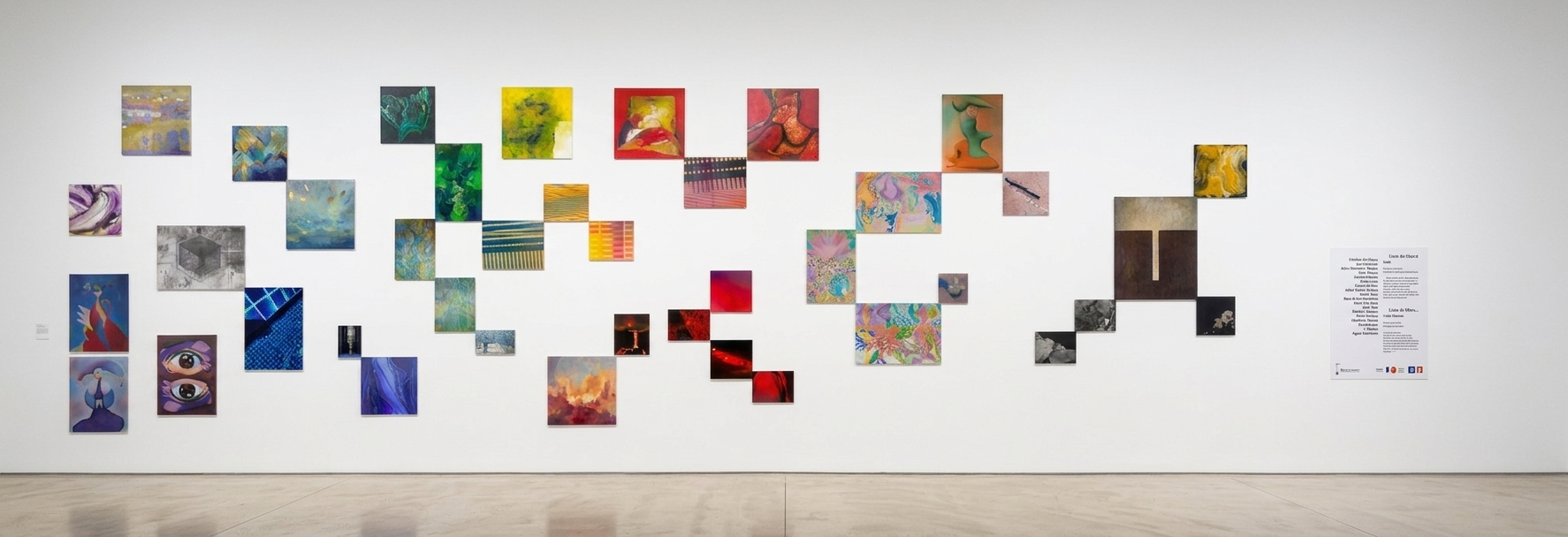
The three works by artist Adelaide de Freitas ("A Deusa da Arte", "A Rainha da Sardinha", and "O Segredo das Pirâmides") are examples of what Arnheim studies as the Egyptian method and orientation. In Adelaide de Freitas's painting, Form and Color summon a territory where myth, imagination, and the exploration of parallel realities merge. More than mere aesthetic creations, the artist materializes pictorial characters of a surrealist nature that seem to inhabit other dimensions and worlds parallel to ours. These figures, shaped through the bold use of saturated and strong colors—such as blue, red, orange, and green—challenge the egocentric view that humanity is the sole expression of life in the cosmos. They are representations that invite the viewer to reflect on the immensity of the universe and the existence of beings with forms that transcend human imagination.
In the context of this exhibition, the sovereignty of these characters made of Light and energy dialogues in a fascinating way with the dynastic jewelry of the Royal Treasure Museum. If the court insignia and crowns used gold and precious stones to materialize the absolute and earthly power of men, Adelaide de Freitas uses Light and Color to crown her own interdimensional beings. The blue and green of her palette refer to the nobility of enamels and emeralds, while red and orange activate the visual energy of phenomenal gems. This approach brings to mind the electric glow of spectrolite and the phenomenon of labradorescence, where bold flashes of rainbow and the magnetism of color function as authentic revelations of other worlds, transforming the canvas into a portal to the infinite.
The work “Ilhas” by Ana Gonçalves establishes one of the most fascinating chromatic and structural bridges of the exhibition, operating precisely on the border where Form and Color cease to be static and are instead dictated by Light. Her composition features a fluid transition that moves between the dense blue tones of enamel—which we find in the historical grandeur of the Plaque of the Military Order of Our Lady of the Conception of Vila Viçosa—and the deep, magnetic green of emeralds, visible in the Medal of the Three Military Orders.
On the axis of Color, this passage from blue to green resembles the gemological phenomenon of pleochroism or labradorescence, where matter seems to contain multiple chromatic forms that reveal themselves depending on the movement of the observer. The blue of the enamel represents the color fused onto the surface, the glassy and controlled reflection of light upon the plane. Meanwhile, the emulated green transports us to the behavior of light inside an emerald: a color that is not superficial, but rather born from the depths of the gemstone, filtered through its natural inclusions that fragment light and give the gem its texture.
The painting "The mighty Pele”, by Barahona Possollo, functions as a portal to Earth's geodynamics, drawing a rigorous parallel with the genesis of the high jewelry in the Royal Treasure Museum. The volcanism suggested on the canvas evokes the explosive, ultra-deep processes (at a depth of over 150 km) that expelled diamonds from the Earth's mantle. Rare magmas, such as kimberlites and lamproites, served as supersonic "elevators", dragging these carbon gems and their xenoliths to the surface before they could transform into graphite. However, there is a crucial time difference. The diamond cycle occurred around 2.5 billion years ago, in deep and stable zones known as cratons, and they were often later dispersed by erosion into rivers and seas. In contrast, tectonic plate dynamics and thermal activity in the crust remain actively alive. Thus, while the diamond cycle fell asleep in time, many gems continue to be generated on Earth at this exact instant as this text is being read. They form much closer to the surface, in the Earth's crust (between 5 and 30 km deep).
Carol Welsch investigates the perception of color as it overlaps, filters, and intersects with other chromatic planes. By exploring the dynamics of light and shadow in Gradient a la fresca and Trama en transició, the artist builds a rigorous optical interplay in which structured lines articulate over diffuse, atmospheric backgrounds. Welsch thus conceptually reclaims the primal gesture of Dibutades while dematerializing it: rather than tracing a figurative silhouette, she paints the very interference and projection of light onto the canvas.
In Llum d'estiu, the palette shifts toward incandescent, solar tones. The piece translates the memory of a Mediterranean summer day, evoking the chromatic vividness of seaside objects and the coolness of the southern Spanish coast. Her pictorial technique, closely akin to weaving, constructs a grid that recalls patterns of fabrics and stretched canvas, converting the sensory memory of the landscape into a vibrant geometric abstraction.
Conversely, in Entre els arbres, the composition articulates the transition between warm colors (yellows) and cool ones (olive greens). The work leads us on a stroll beneath the canopy of trees, capturing the breeze among the foliage while evoking the Japanese concept of Komorebi—the poetic effect of sunlight filtered through branches and leaves. The Japanese artists Hiroshige and Hokusai also incorporated this poetic effect into their masterpieces.
In gemology, this phenomenon finds its perfect reflection in the characteristic color zoning of polychrome tourmalines (yellow and green). From a mineralogical perspective, yellow in gemstones arises through various chromophoric processes—from the presence of nitrogen in yellow diamonds to the composition of the ultra-rare Imperial Topaz and chrysoberyls. In the collection of the Royal Treasure Museum in Lisbon, this golden luminosity stands out in major historical pieces, such as shoulder clasps and insignia set with yellow diamonds and Brazilian topazes.
The color yellow takes on a central role in this exhibition, proving vital to Carol Welsch’s work. It is an ancestral color, extracted in antiquity primarily from orpiment—a vibrant golden-yellow arsenic sulfide mineral, highly toxic and widely used in the past as a pigment. Its name derives from the Latin auripigmentum ("gold pigment"). Pliny the Elder described it as such, noting that its characteristic luster fueled the belief that the mineral actually contained real gold, while also mentioning its paradoxical use in medicinal ointments despite its well-known corrosive effects.
Throughout Art History, yellow has played decisive roles: for Giotto di Bondone, it served as the gravitational center that pulled the viewer’s gaze; Vermeer combined various shades and pigments to capture filtered sunlight through subtle optical illusions; and Turner, in his reflections on Light and Colour (Goethe's Theory), saw yellow as the primary source of light and strength, placing it at the apex of his chromatic triad (followed by red and blue).
For Kandinsky, color and sound were intrinsically linked through the phenomenon of synesthesia. In his famous work Impression III (Concert) (1911), yellow emerges in direct response to Arnold Schoenberg’s atonal music. Rather than the filtered sunlight found in Entre els arbres, yellow here expresses the very resonance of music expanding through the air like a vibrant wave. In his essay Concerning the Spiritual in Art (1911), Kandinsky would associate yellow with the sharp sound of brass instruments.
Later, Paul Klee and Josef Albers would deepen the study of yellow and its chromatic interactions—demonstrating how it alters and influences red and neighboring colors, a dynamic of contagion and vibration that vividly echoes within the structure of Llum d’estiu.
Cristina Albaker manages, through her photograph “Briolette”, to present a mystical game of chiaroscuro in a creation that mimics the delicacy, shape, and volumetry of a high jewelry pendant. The structure closely resembles a rough diamond, just as it is removed from the kimberlite matrix rock, displaying textured surfaces and cleaved points. Simultaneously, its elongated silhouette refers to the sophistication of a diamond cut into a briolette shape. This piece of ice establishes a dialogue with one of the pieces richest in memory within the museum's collection: the Pearl Breastpin, a historical piece offered by King Victor Emmanuel II to his daughter, D. Maria Pia, upon her marriage to King D. Luís in 1862. Just as the royal pin combines the opulence of diamonds with the softness of hanging pearls, the artist's contemporary interpretation captures the essence of that magnetism, uniting historical heritage with the ephemerality of current creation through the pure geometry of light.
Daniel Schär exhibits three works whose canvases are dominated by distinct colors: yellow in “What becomes clear”, green in “Underwater”, and red in “Litany”.
In the red-toned work titled “Litany”—inspired, according to the artist, by the composer Arvo Pärt—we are enveloped by a mass of intense red that immediately evokes the presence of ruby or the extremely rare red diamond. This chromatic richness establishes a direct visual relationship with the large Rubies of the Royal Treasure Museum collection, historical symbols of dynastic power and authenticity.
The red diamond, although absent from the museum's collection, represents the pinnacle of colored diamonds (the so-called fancy colors). This is the rarest color in nature: the more saturated and strong its tone, the more valuable and scarce the mineral becomes. The best example of this extreme rarity is the “Winston Red” diamond (2.33 carats). Regarding it, Wuyi Wang, vice president of research and development at GIA, stated: ”A natural diamond obtaining a fancy red color grade is something extremely rare. First, it needs to have a perfect color within that range, and then, the saturation must also be flawless. If it is too dark, it turns to black; if it is too light, it turns into pink.”
At the center of the composition of “Litany”, a yellowish stain evokes the image of a gemological inclusion observed under a microscope. In the real world, although clarity dictates commercial value, these "imperfection" are nature's signatures that prove a gem's authenticity against a synthetic imitation. In the case of a red diamond, an internal yellow zone generally indicates the presence of nitrogen.
Created to the sound of the band Tim Freitag, the emerald-toned work “Underwater” displays lines that evoke the internal fractures of this gem. Despite its high hardness on the Mohs scale (7.5 to 8), emerald possesses poor toughness due to raw structural tensions, making it notoriously fragile to the touch and when setting—a delicacy visible in the Museum's impressive insignia. On the other hand, this dense green also resembles that of a highly rare green diamond. Unlike the emerald, this diamond owes its color to an extreme process: prolonged exposure to natural radiation deep within the Earth, a geological phenomenon immortalized by the famous Dresden Green.
Finally, in the work “What becomes clear”, the vibrant yellow collides with dark masses in a chromatic field that evokes peridot. This is an idiochromatic gem, meaning its olive-green color is born from its own iron-rich composition, rather than from external impurities. Named the "gem of the sun" in Ancient Egypt and a favorite of Cleopatra, peridot reached its peak in European sacred art, shining in monumental pieces such as the reliquary of the Three Kings Shrine in Cologne Cathedral.
The conceptual dialogue of this exhibition materializes in an exemplary way in the artistic photography of Isabel Soares dos Reis. In this macro-vision of the outside world, we see the mirror of gemological microphotography. Her work can be interpreted, through its geometric lines and planes of light, as visually reflecting the phenomenon of internal graining—the stress and growth lines engraved within the deep atomic structure of a diamond. On the other hand, by capturing the luminous and fluid trail of a bird in motion against a branched background, it simulates a feather (the feather-like internal fractures that inhabit minerals) as the dynamic effect of photofluoroscopy, where matter seems to glow in the dark upon reacting to light.
Jessica Dunn presents a series of four works that navigate the boundary between the figurative and the abstract. Through a harmonious fusion of warm and cool tones interconnected with gold leaf, the artist constructs a striking visual language.
Painted in oils, a dominant palette of ultramarine, turquoise, and Kings blue draws the viewer into the immersive depth of each canvas. In Along the Way and Resonate, the blue pigments establish a dialogue between the exuberance of gold and the serenity of colour. Meanwhile, in Life Force, the vibrant violet hues and gleaming gold leaf create a compelling aesthetic tension, marrying the traditional hue of royalty with the luxury of precious metal.
In this way, Jessica's work explores an ancestral tradition. The use of gold leaf in art dates back to the Egyptians, Mesopotamians, Greeks, and Byzantines, extending into the Middle Ages through manuscript illumination (a technique known as chrysography). The artist builds a conceptual bridge between historical richness and contemporary art—evoking the memory of the Royal Treasure Museum and the gold nuggets from Brazil. Much like Botticelli, Titian, or Gustav Klimt, Jessica Dunn uses gold to transcend the ordinary. By combining the intrinsic rarity and our fascination with this precious metal with her abstract and figurative language, the artist creates works brimming with light and beauty.
With the photograph “What goes up must come down” by Marc Gulbenkian, we are transported to the field of animal biology through the figure of a peacock, whose electric blue contrasts with the pinkish-red tone of the wall. A supreme symbol of royalty and status in the India of the Maharajas, the peacock displays a deep blue that evokes the brilliance of sapphires and opals. However, the bird's true secret lies in physics: its feathers possess geometric nanostructures that split and reflect light, creating the phenomenon of iridescence. This shifting play of colors is the same found in the biological and mineral kingdoms with mother-of-pearl—a dazzling effect that can be appreciated in the Museum's collection through the Royal Fans, snuffboxes, and tobacco boxes.
Marjorie Salvagni exhibits three paintings from her ‘Série Transmutações’. These works are highly representative of what inspires jewelry: the perfect symbiosis between art and the natural world. This symbiosis finds an echo in Lancelot Law Whyte's Structural Morphology, which argues that all living structures share a coordinated system of symmetry and transformation. From this perspective, organic matter is always in a process of transition (mutation) to achieve balance, turning the work into a visible record of a dynamic process of growth, mutation, and internal coordination that governs both biology and the cosmos.
A prime example of this dialogue between jewelry and the natural world is Cartier—one of the world's most prestigious high jewelry houses and creator of pieces for several European courts—which adopted the panther (depicted on the canvas flanked by lush tropical flora) as its iconic symbol, immortalizing the strength and sinuous movements of nature in metal and precious stones. It was regarding the splendor of this house that King Edward VII of the United Kingdom coined the famous maxim: "Cartier, the jeweler of kings and the king of jewelers.”
In a composition of rich and varied colors, Salvagni's work harmonizes the fragility of organic elements, such as pearls (born from life itself), and the strength of inorganic ones, materialized in the diamond floating at the top of the canvas. The gem is depicted in its classic and universal brilliant-cut profile, where the crown, girdle, and the geometric facets of the pavilion that taper toward the base are clearly distinguishable. This faceted structure introduces a crystalline and symmetrical rigidity that contrasts with the organic fluidity of the surrounding vegetation. In pearls, this chromatic richness manifests through the phenomena of Matiz and Oriente (Overtone & Orient): the former revealing the subtle secondary hues that float over the base color of the gem; the latter, its deep, iridescent luster that seems to emanate from within. This material and chromatic duality refers directly to the Plaque of the Three Military Orders, one of the greatest masterpieces in the museum's collection, where the dialogue between the "fire" of diamonds and the glow of colored gems dictates the absolute rhythm of light.
The work of Maria João Vale displays pieces that contrast between red and blue, in a palette that refers to the magnetism of the rubies and sapphires in the Museum's collection. The work “Piscina”, in shades of blue, functions as a macroscopic metaphor for gemology: the undulating reflections of water precisely illustrate the phenomena of Brightness, Scintillation, and Refraction. While the upper half reveals the stable geometry of the tile grid, the lower half shows light passing through water, altering its speed and direction. This process of Refraction is analogous to the behavior of light inside a gem, dictated by its Refractive Index (RI). The areas where light is intensely returned represent Brightness, while the fluid movement that generates flashes and dark areas exemplifies Scintillation. The saturated blue also evokes the blue fluorescence of gems under ultraviolet radiation, building a bridge to the famous “Portuguese Diamond”. Furthermore, the turbulence of the water acts as living facets that decompose light, illustrating the concept of Fire or Dispersion (the separation of white light into the colors of the rainbow when passing through a dense medium). This Dispersion effect is amplified in simulants like Cubic Zirconia or Moissanite, but it also manifests in a unique way in the Portuguese Crown diamonds exhibited in the Museum, characterized by their antique cuts, such as the rose cut, the old mine cut, and the old European cut.
In this exhibition, Maria Reis presents five works that navigate between warm and cold tones, establishing a visceral dialogue with the colors and physical properties of gemstones.
The work Azul Profundo ("Deep Blue"), in shades of blue, violet, and silver, immediately evokes the intensity of sapphire. The piece establishes a direct connection with the iconic Tiara of Queen Maria II, on display in this Museum. Composed of 1,415 diamonds and five Burmese sapphires, it is the oldest known tiara with a direct link to a Portuguese monarch. The pictorial flow of the canvas evokes not only the gem's pleochroism, but also the historical combination of blue and white, which symbolized the liberal monarchy.
On the other hand, the work Enigma plunges into the hue of emerald. The dark green and its deconstructed organic forms recall the emerald bodice bow from the Royal Collection, reconfigured here as a matter of memory or dream. There is an intentional duality in the painting: it simultaneously evokes the structure of armor and the fragility of the female body. It is the most intimate and mysterious piece of the series—exploring anatomy as a jewel.
The work Sangue e Poder ("Blood and Power") addresses themes of lineage, passion, and sacrifice. The vibrant red evokes the chromatic depth of rubies and spinels. The canvas dialogues with the monumental insignia of the Order of the Golden Fleece (early 19th century, commissioned by King John VI), studded with rare diamonds and deep-toned rubies. Maria Reis introduces golden and yellowish hues into the pictorial fabric, characteristic of inclusions and the refraction of rough ruby.
Ametista Real ("Royal Amethyst") is a work featuring the vibration of violet with the silver and iridescent delicacy of pearl. The composition translates the aesthetics of the Royal Family's private adornments into a contemporary language—namely 19th-century dressing table sets and jewelry that combined semi-precious stones with strands of natural pearls and silver mountings. The work stands out as an exquisite artistic reinterpretation of private collecting and personal adornment.
Ouro Líquido ("Liquid Gold") needs no introduction: it is the celebration of the noble metal par excellence and the light that articulates all the other works. It represents the fluid gold that transcends—the golden light that bathes and consecrates the idea of treasure. It connects directly with the Brazilian Gold collection core, evoking the nuggets, ingots, and coins that constituted the reserve of the Portuguese Crown in the 17th and 18th centuries.
In the journey of this exhibition, Martin Stranka's work emerges as a powerful anchoring point for the human factor—the final receptacle where the physics of light transforms into emotion through the retina. By presenting a black and white photograph focused on the eyes, the artist rescues our own capacity to witness and interpret the world, connecting the science of vision to the depth of the soul. These eyes, which form part of a dense and intimate series that the photographer dedicated to the theme of loss, float in a space framed by the absolute void of a black background. Here, the gaze manifests as a complex symbol where affirmation, grief, and denial coexist. Under Stranka's lens, the ultimate duality of physics and art operates: black as the absolute absence of color and white as the mystical totality of light.
When analyzing Martin Stranka's work, we realize how it aligns with Rudolf Arnheim's view on the frontal gaze—exemplified by Arnheim in the face of Christ by Albrecht Dürer. The theorist explains that this isolated gaze creates a direct vector force with the viewer: the eyes cease to be mere anatomy and become the center of the message, functioning as a perceptive magnet that demands an immediate psychological reaction.
Historically, the color/pigment black evokes the opulence of European royalty itself: between the 15th and 17th centuries, black pigment was one of the most expensive and difficult to obtain, serving as the ultimate symbol of wealth, authority, and aristocratic sophistication.
In high jewelry, this same density gains new life through black diamonds. Originally discovered in 1841, in a post-colonial era, in the Bahia region of Brazil—where they became known as "carbonados"—they were used for industrial purposes.
The black diamonds became famous later, in the late 1990s, when Swiss designer Fawaz Gruosi, founder of the De Grisogono house, elevated the black diamond to luxury status. In Stranka's work, black reclaims all this historical and mineral weight: it ceases to be a mere background and becomes the deepest presence of the exhibition—the place where light withdraws to make room for memory.
Mónica de Morais creates a work that pulses in perfect harmony between light, form, and color. In her first creation, 'Passagem', shadow emerges as the main element, projected by the light falling upon an apparent 'cross' or a 'T' generated by the contrast between light and dark. Here we find the four fundamental elements of this exhibition: shadow, light, form, and color. The cross is the meeting point, the border, and the transition between the horizontal and vertical planes, between light and dark.
A letter format widely used in jewelry since medieval times. Meanwhile, in the work '9', which represents a cube falling apart in dark, grayish tones and black lines, the artist refers us to the cubic (or isometric) crystal system. This is the internal structure of highly symmetrical and valuable gems, evoking here a diamond in deconstruction, disappearing. Knowing that, within the diamond structure, each carbon atom is covalently bonded to four other carbon atoms arranged at the vertices of a regular tetrahedron, the artist subverts this scientific rigidity with the number '9'. The artist thus uses the Form of Distortion or Deformation (Deformation) described by Arnheim, subverting the geometric rigidity of the diamond's atomic structure with the mysticism of the number that titles it.
Rita Andrade presents a figurative approach focused on the eyes and the color purple. The eyes symbolize here the very vehicle of human vision, the absolute receiver without which it would be impossible for the retina to capture the play of light and color that governs this exhibition. In parallel, the purple tone lends the work an aura of exclusivity associated with royalty and the clergy, in a direct allusion to amethyst. This gem, which we admire today in major historical collections—such as the Royal Treasure Museum's holdings—held a status of immense preeminence for centuries in court jewelry and ecclesiastical insignia. By placing the gaze in confrontation with purple, the artist invites the visitor to rescue the historical memory of luxury and devotion, transforming the act of seeing into an experience of almost sacred contemplation. Before the discovery of the large mines in Brazil in the 18th century, amethyst was as rare and valuable as ruby or sapphire. Purple was the color of power, obtained through highly expensive processes in antiquity (such as Tyrian purple). Since amethysts were scarce (the main sources being Siberia and Egypt), only royalty and the high clergy could finance them—hence their traditional use in Bishops' rings and Crown Jewels. Amethyst possesses pleochroism, an ability to show different colors when viewed from different angles.
In RVieira's work, the green of nature merges with the mineral nobility of the emerald. By capturing a landscape where light falls directly upon vegetation, the artist transfigures the space, unfolding it into infinite greenish shades. This connection evokes, in an almost mystical way, the very 'jardin' (garden) of emeralds—the technical name given to the internal inclusions of the gem that mimic botanical life—proving that light, upon touching matter, has the power to transform landscape into a jewel. The green color in plants comes from chlorophyll, which absorbs sunlight to generate life. In emeralds, green is born from the absorption of light by traces of chromium and vanadium. By painting light falling on vegetation, the artist is replicating the exact optical miracle that the Earth performs to color the gem. Already in the 1st century, the philosopher Pliny the Elder (the same from the myth of painting) wrote in Book XXXVII (the 37th volume), which is entirely dedicated to precious stones and gemology - "No color is more delightful to the eye. For, while we look at other gems and herbs, we tire, but the emerald, when we look at it, refreshes our vision and does not fatigue with its contemplation; and gem engravers, when working on them, have no better means of resting their sight than by fixing their gaze on this stone.” Pliny the Elder.
In the case of the work “O Galo”, we are dealing with animal biology rather than plant biology. The rooster assumes an incontestable beauty in Portuguese culture, highlighted by the complexity of its plumage and crest. The rooster's plumage, much like the peacock's, exhibits a fascinating structural iridescence.
When light falls on the feathers, it creates a dynamic visual effect that, while evocative of the physical phenomenon of pleochroism or the play of colors typical of gems, results from a process of diffraction and light interference within the feather's microstructure. Depending on the viewing angle (observation symmetry), certain light waves are canceled out while others are reinforced, making the rooster appear to change hue—from metallic blue to emerald green or copper.
The rooster's plumage is a perfect example of geometric biomorphism. If we magnify the surface of one of its feathers, we will observe a grid of elements aligned just as rigorously as atoms in a crystalline structure. It is this repetitive organization that "breaks" white light and returns pure, saturated colors to us, functioning in a way analogous to a faceted gem, whose geometry is precisely calculated to maximize its "fire" or light dispersion.
Teymur Rustamov's work transitions fluidly between violet and red, generating a chromatic gradient that echoes a fascinating phenomenon of the mineral kingdom: color zoning. This transition, frequently observed in sapphires and bicolor tourmalines, reflects variations of matter on the canvas itself, as if the painting were imitating the organic growth of a crystal. In nature, chemical growth fronts merge subtly, creating an imperceptible passage where violet slowly dissolves until it transforms into red. Tourmaline, considered an authentic mineralogical chameleon, perfectly illustrates this mutation: its tonal transition (frequently associated with the indigolite and rubelite varieties) occurs due to fluctuations in the concentrations of manganese and iron in the deep hydrothermal solution.
Teymur Rustamov seems to accurately reflect the vision of Lancelot Law Whyte, for whom the absence of a rigid geometry does not mean a lack of logic, but rather a dynamic and fluid pattern that has been "frozen" in time, just like the deep chemical growth of a bicolor tourmaline born from the dialectic between the parts and the whole.
To deepen this intersection between Light, Form, and Color, we invited a panel of specialists from various fields to share their vision. In this leaflet, you will also find educational and scientific material designed to enrich your experience.
We hope you enjoy this unique journey between the contemporary exhibition and the permanent collection of the museum. Have a wonderful visit!
The Curator: Francisco Lacerda